
Sharshi's Story


In a semi-detached house at the end of a residential street live Sharshi and her daughters. Ivy (15) and Blossom (13).
“This is our sanctuary, where we spend most of our time and know we won’t be judged,” Sharshi shared with a mix of sadness, pride and love. “I enjoy filling our home with interesting things to look at.”
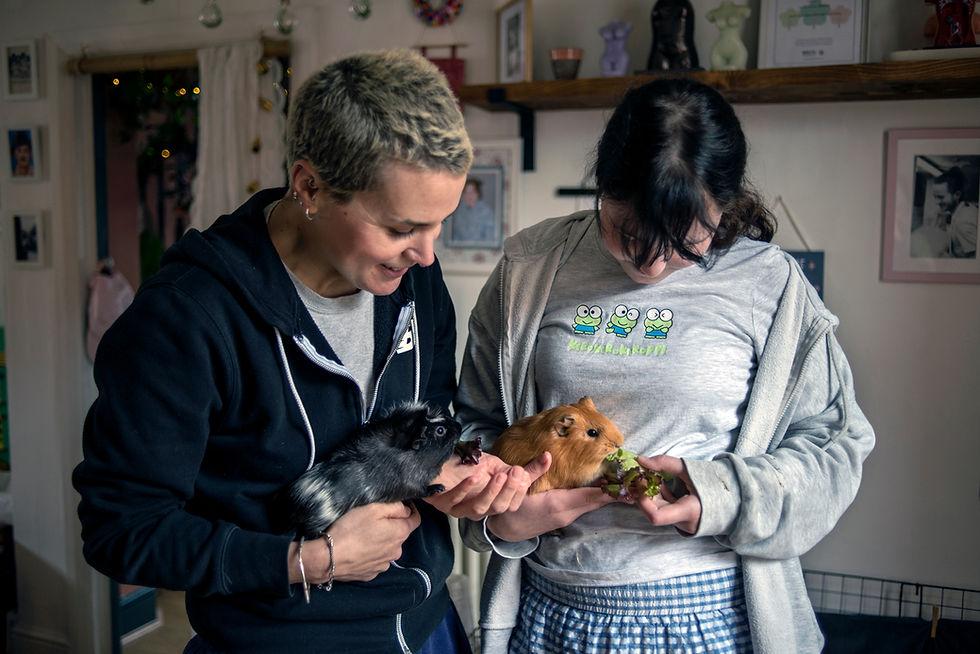
Their house is filled with colour: photographs, thriving houseplants and upcycled printer trays holding tiny treasures. Sharshi uses art and decorating as a form of meditation and therapy: some time out, or something she can do with her girls. A moment to ‘zone out and hyperfocus’ which, she says, helps her regulate and meet her own needs. It’s also important to mention the furry members of their family: four guinea pigs, all with a name beginning with the letter P, and two cats.

“I’m neurodivergent and a single parent carer to my two teenage daughters, who are also neurodivergent and experience mental health difficulties,” Sharshi explained. “I never used to think about or describe myself as a carer. I saw what I did simply as being a mother, so I don’t tend to speak about it.” Sharshi describes herself primarily as a mother, while also providing significant unpaid care A carer is defined as a person of any age who provides unpaid care and support to a family member, friend or neighbour who is disabled, has an illness or long-term condition - or who needs extra help as they grow older (Carers UK).

To her own surprise, Sharshi has signed up to carer card schemes so she can support her daughters to venues like the cinema, but she has not really allowed the title to sink in. “I haven’t allowed myself to appreciate that ‘crown’ I wear; the role I have,” she admits. But having accepted it officially, if not emotionally, she will be able to access support. Carers UK research found that on average it takes 2 years for parents to identify themselves as a carer. For many parents of children with additional needs, the extra support they provide goes unnoticed as they consider it part of their regular parental responsibilities. A major barrier to accessing help is the act of first acknowledging their role as a carer.
Both Ivy and Blossom attend a specialist education provision. “I’m very grateful, as it truly is the most nurturing and understanding place for them,” Sharshi said. However, the girls' attendance is low.
“We’re working on getting back into school, aren’t we?” says Sharshi. Blossom looks at the floor.
“We’re starting with only attending school for the lessons you enjoy,” Sharshi adds. Blossom smiles and replies, “Cooking and film club.”

This new timetable is beginning to work for the girls, allowing them to build confidence in attendance. But it means Sharshi has to drive the girls back and forth, often just for one 50-minute lesson. Sometimes she sits in a nearby cafe as there is not enough time to get home and back. She finds this stressful rather than relaxing, as it’s a barrier to gaining employment. She sits thinking of the many things she needs to do but can’t, and has to spend money on a non-essential drink. Sharshi had started her own business selling house plants but had to sell it because of the girls’ increasing needs. “It was my dream job,” Sharshi shared sadly.
Sharshi and Blossom are doing some maths using an exercise book they bought in the local supermarket. “I think this is right - my maths isn’t very good though,” Sharshi chuckles uncomfortably. She reads each question, waits for Blossom’s answer, and encourages her throughout (“That was really quick,” “Good job, Blossy.”) Blossom points to the next question, and they both support each other to stay focused.
“We know where you are now and can move up to the next level next time,” says Sharshi. “It’s good for your confidence to see how much maths you already understand.”
One of the challenges right now is getting the balance between putting in boundaries and building the girls’ self-esteem. Sharshi has recently moved the Wi-Fi router to her bedroom, which she keeps locked. “We have a real challenge with the internet,” she explained. “I don’t want the girls to spend all their time on their devices, especially not unseen in their room. I know too much exposure to the online world is unhealthy, but they don’t understand this yet.” She is having to work out how best to help them regulate their emotions. Ivy finds it difficult to keep her room tidy as she struggles with executive functioning, and Sharshi has to decide the best way to support this.

“I’d love to make her space tidy, but I don’t think that would be right for her,” Sharshi explained. “I feel her room reflects how her mind works: hundreds of thoughts firing at once in different directions. It’s her space and a representation of her struggles.”
The family are receiving family therapy from the Child and Adolescent Mental Health Service (CAMHS). This started after Ivy was struggling significantly with her mental health and tried to take her own life. Therapy is a new journey for them, but Sharshi is feeling positive about it. She is also grateful that, having grown up with siblings on the autism spectrum, both she and her parents - who live nearby - have experience with neurodiversity. Sharshi is about to request a Carer Conversation with her local council to see if she can access a Carer Breaks Fund. This would enable her to buy a sewing machine and get some lessons, helping her explore something she wants to do for herself.

Ivy chose not to be in the photographs but is happy for her mum to share parts of her story.


Comments